


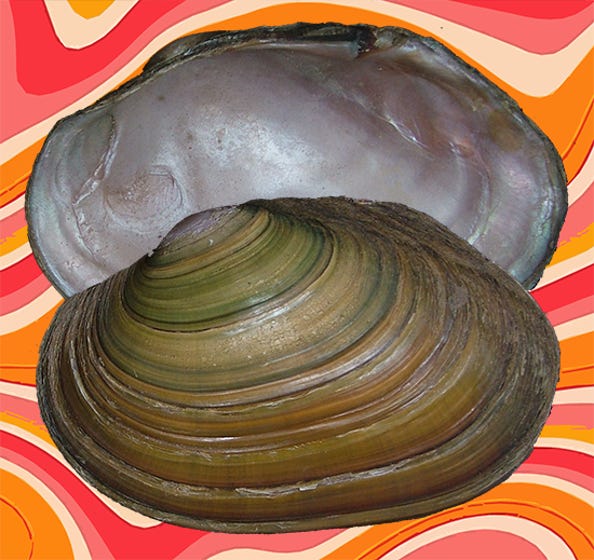
When freshwater mussel-ologists want to turn-on the uninitiated, we often point to the mollusks’ well-studied parasitic larval stages and the array of spectacular adaptations associated with their life cycles. But for African unionoids, it is more about what we don’t know.
Mussel of the Month Chambardia rubens is a freshwater mussel widely distributed in Africa, from the Nile Basin west through endorheic Lake Chad to the Senegal and Niger rivers of West Africa (MUSSEL Project map). Such a broad geographical distribution across a continent in now-isolated basins is shared by other widespread mussel species like Coelatura aegyptiaca and Mutela rostrata. There is some interesting biogeographical history going on there to explain why these species have such expansive ranges, but part of the answer is likely that they don’t — that the current taxonomies for Mussel of the Month Chambardia rubens and the other taxa lump together multiple closely related species. Our knowledge of African freshwater mussel biology and classification is less robust than for mussels in better studied parts of the world.
The MUSSEL Project Database (MUSSELpdb) is a useful resource for exploring freshwater mussel diversity and evolution. Subscribe to this Substack for free to keep up with latest news and views.
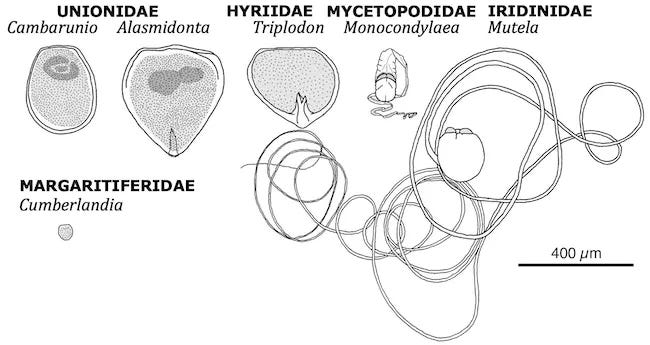
Mussel of the Month Chambardia rubens is one of 11 Recent species in the genus Chambardia (also in the literature as Spathopsis), and it is one of only two with published descriptions of their larval morphology: they both have lasidium-type larvae (Kenmuir, 1980; Morad et al., 2018). Among freshwater mussels, there are two distinct larval morphologies: glochidia as seen in the families Unionidae, Margaritiferidae, and Hyriidae, and the lasidia of the Iridinidae, Mycetopodidae, and Etheriidae. The latter three families comprise the superfamily Etherioidea — the “lasidium-bearing mussels” (Graf & Cummings, 2006).
In general, both parasitic larval morphologies seem to function similarly: both glochidia and lasidia infect fish (or occasionally amphibian) epithelia to complete their metamorphosis. Unlike the external fertilization of marine bivalves, freshwater mussel females exhibit parental care, brooding their developing larvae within gills spaces. It is from these marsupia that glochidia and lasidia are released to find their host, undergo metamorphosis, and seek their fortunes as juvenile mussels. This bizarre-for-a-bivalve reproductive style has spawned diverse mechanisms to improve the odds of contacting a suitable host, including the evolution of various lures and behaviors. More information about general freshwater mussel life cycles can be found in various places — e.g., Cummings & Graf (2009), other articles on this Substack, and Prof. Chris Barnhart’s splendid Unio Gallery.
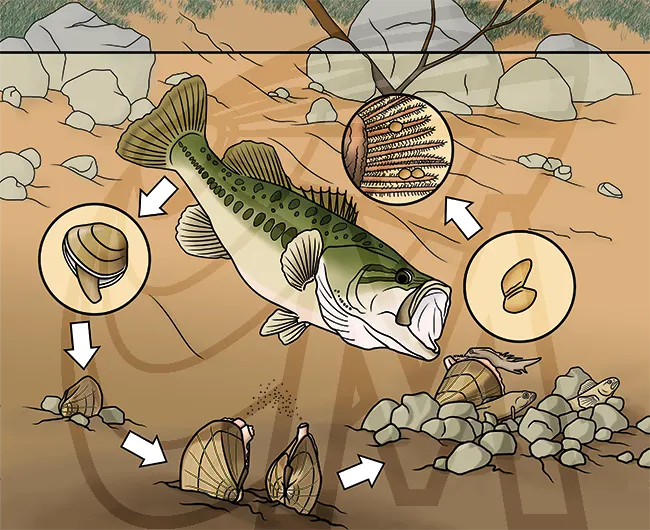
Glochidium-type larvae have been well-documented for their roles in mussel propagation and the value of their variation for classification (Pfeiffer & Graf, 2015). Pre-metamorphosis glochidia resemble bivalves in that they have two, tiny calcareous valves lined by a thin mantle. Some have a larval thread, and others have variously developed marginal hooks. Suffice it to say in an article focused on mussels without glochidia, there is ample information out there about the structure and function of glochidium-type larvae.
The story isn’t as complete for the lasidium-type larvae. The larvae of South American Anodontites (Mycetopodidae) were first described and named lasidia by von Ihering (1891). However, they weren’t noticed much after that — Ortmann (1921) complained that none of his Neotropical specimens were gravid — until the mid-20th century when lasidia were “rediscovered” (Parodiz & Bonetto, 1963). Lasidium-type larvae have been reported from genera representing all four subfamilies of the Mycetopodidae: Anodontites, Leila, Monocondylaea, and Mycetopoda (Wächtler et al., 2001).
Mussel of the Month Chambardia rubens is classified in the family Iridinidae and it has been reported to have lasidia. Morad et al. (2018) provided excellent micrographs confirming this, and the larvae look similar to the lasidia of sympatric Mutela rostrata (Garo Varjabedian, 2006).
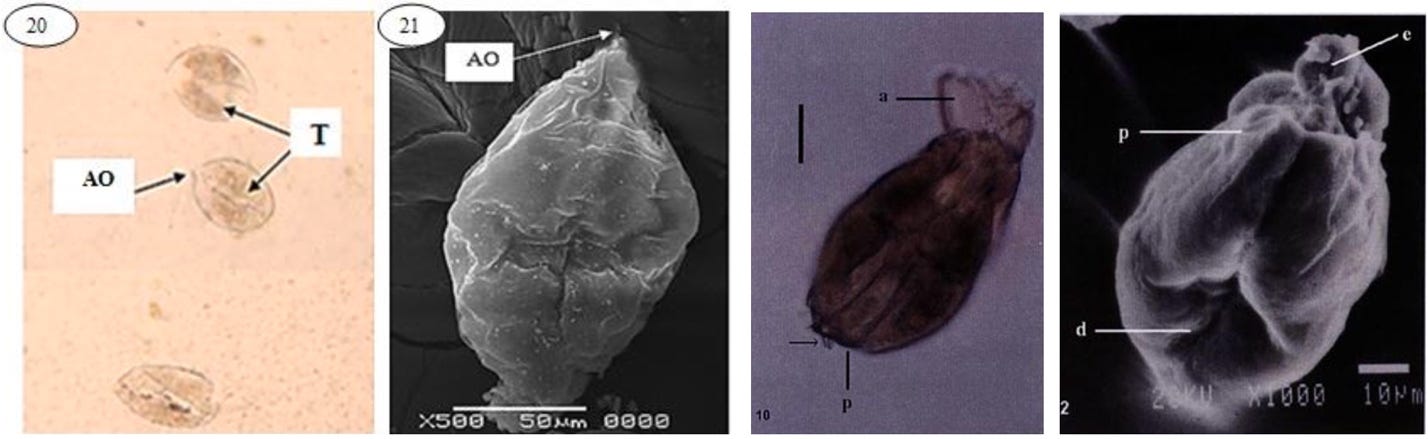
Lasidia lack a calcified, bivalved shell. They have a pair of hooked lobes at their posterior ends, often with a long thread.
Among the African iridinids, lasidium-type larvae have also been observed from Mutela bourguignati and M. zambesiensis and Chambardia wahlbergi (Fryer, 1959; Kenmuir, 1980). That is a short list!
There are also reports of glochidium-type larvae among African iridinids. Franc (1949) provided no description and surely used “glochidies” as a general term for freshwater mussel larvae in the specimens of Mutela dubia and M. rostratathat he studied. Meyer (1958) went to the trouble of figuring sections of the marsupium of Pleiodon spekii from Lake Tanganyika (see below) and was adamant that the poorly preserved larvae therein were glochidia, “... den Larven nicht um Lasidien, sondern vielmehr um Glochidien handelt” (p. 29). Meyer’s observations of the soft-anatomy seem spot-on, so it is difficult to reconcile such an error with the larvae. Kondo’s (1984) description of the glochidia of Moncetia anceyi(also from Tanganyika) resulted in a reclassification from Iridinidae to Unionidae (Graf & Cummings, 2021).
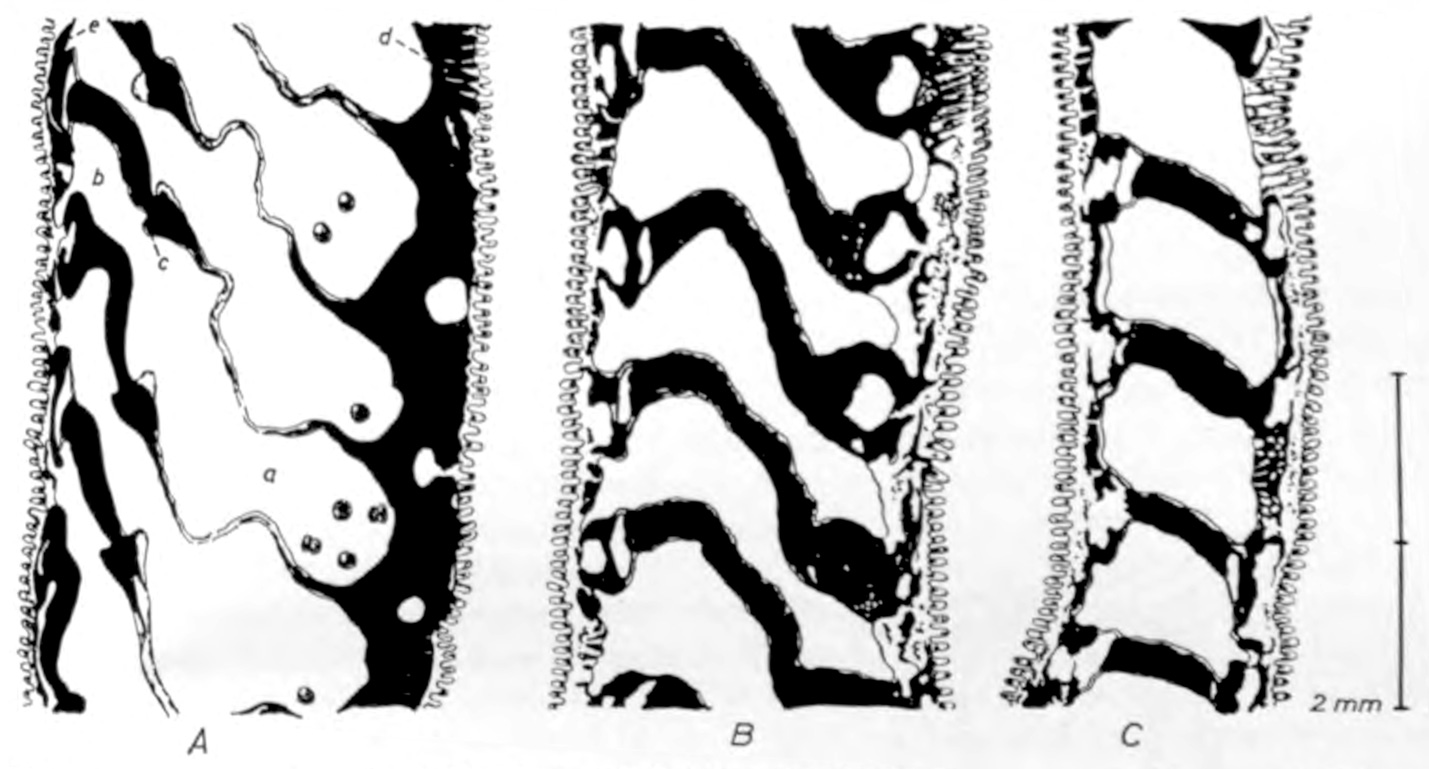
If there have been only a few observations of larvae among African iridinids, there have been even fewer documented cases of metamorphosis on their hosts, but that is where things get really interesting. From what is known of South American lasidia, the larvae encyst on their host fish, similar to what happens with glochidia. However, the generality of that process is extrapolated from surprisingly few data points — in their review, Wächtler et al. (2001) offered only one sentence of discussion and figures for only a single, misspelled species, Anodontites trapezialis.
A second mode of transformation has been observed for two species of Mutela in Africa: the lasidium larva is followed by a second larval stage dubbed a haustorium. Fryer (1959, 1961) described the metamorphosis of M. bourguignati from Lake Victoria, and that work was followed up by Falk et al. (1996). Rather than transformation to a juvenile occurring within the protection of a cyst formed of host tissue the haustorium phase has the juvenile mussel developing while dangling from the host by a tubular appendage — the stalk. An identical developmental process was described for M. zambesiensis by Kenmuir (1980).
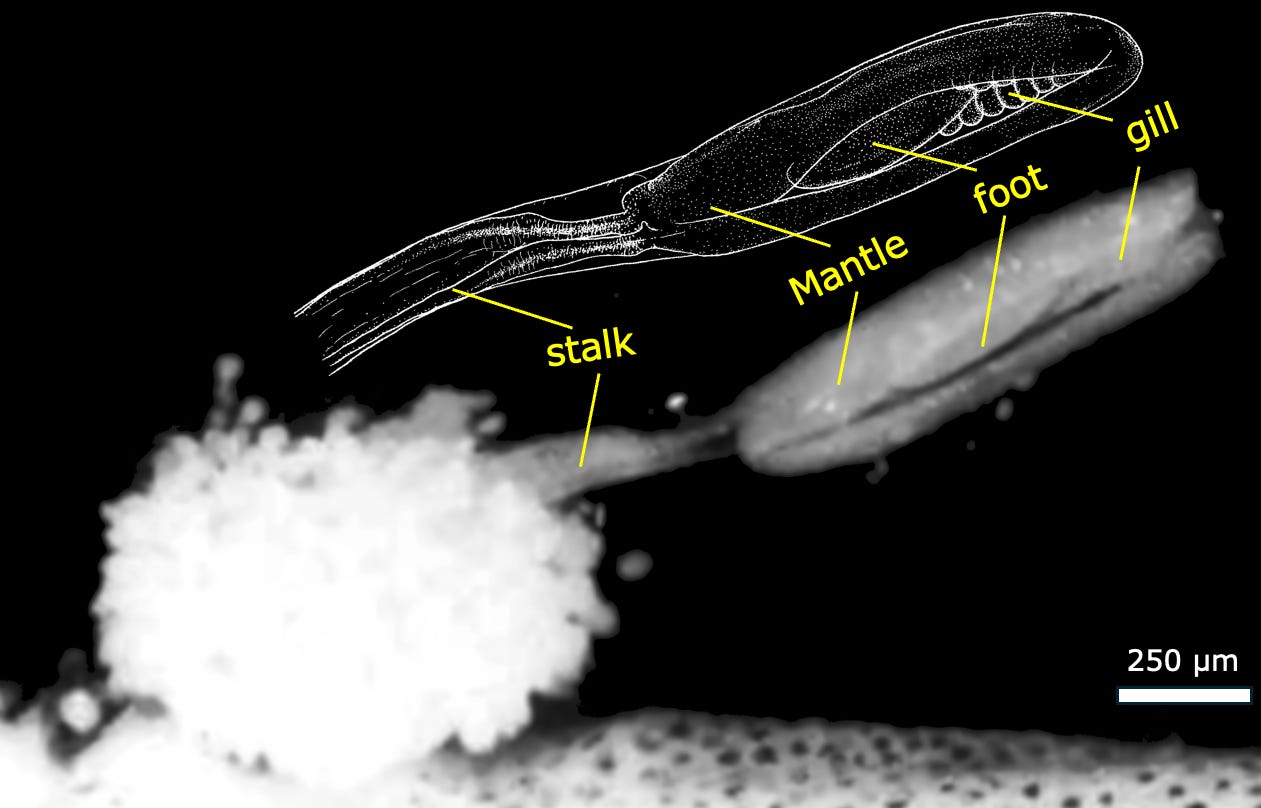
While the lasidia of Mutela and Chambardia are similar, we don’t know whether Mussel of the Month Chambardia rubens completes its metamorphosis in a cyst like Anodontites from South America or with a haustorium like Mutela from Africa. At least we can feel confident that the larvae of Mussel of the Month Chambardia rubens has been photographed at least once! There are many more species of Chambardia and Mutela for which we have no data — not to mention all the other genera. Our knowledge of the larvae of the so-called “lasidium-bearing mussels” of the Etherioidea can charitably be described as meager.
I have personally observed evidence that Chambardia wahlbergi does at least use its lasidia to infect fish. The artificial tilapia breeding ponds that we sampled in Zambia are infested with mussels! Those enclosures could be a ready site to fill in some important data gaps in our understanding of freshwater mussel reproduction.
References Cited
Cummings, K.S. D.L. Graf. 2009. Mollusca: Bivalvia. [in] J.H. Thorp & A.P. Covich (eds.). Ecology and Classification of North American Freshwater Invertebrates, 3rd edition. Academic Press-Elsevier, New York. pp. 309-384.
Falk, L., F. Herrmann & K. Wächtler. 1996. Mutela bourguignati: An African freshwater bivalve with an unusual development [abstract]. Verhandlungen der Deutschen Zoologischen Gesellschaft 89: 326.
Franc, A. 1949. Unionidae d’Afrique occidentale Française recueilles par Th. Monod. Journal de Conchyliologie 9: 157-187.
Fryer, G. 1959. Development in a mutelid lamellibranch. Nature 183: 1342-1343.
Fryer, G. 1961. The developmental history of Mutela bourguignati (Ancey) Bourguignat. Philosophical Transactions of the Royal Society of London B 244: 259-298.
Garo Varjabedian, K. 2006. The early development of two unionoid bivalves from the River
Nile, Egypt. Journal of the Egyptian-German Society of Zoology Vol (50D): Invertebrate Zoology & Parasitology 139-152
Graf, D.L. & K.S. Cummings. 2006. Palaeoheterodont Diversity (Mollusca: Trigonioida + Unionoida): what we know and what we wish we knew about freshwater mussel evolution. Zoological Journal of the Linnean Society 148: 343-394.
Ihering, H. von. 1891. Anodonta und Glabaris. Zoologischer Anzeiger 14(380): 474-484.
Kenmuir, D.H.S. 1980. Aspects of the Biology and Population Dynamis of Freshwater Mussels in Lake Kariba and Lake McIlwaine. Thesis (Ph.D.)-University of Natal, Pietermaritzburg.
Kondo, T. 1984. Hosts of the larvae of Moncetia lavigeriana (Bivalvia: Mutelidae) in Lake Tanganyika. Venus 43(4): 347-352.
Morad, M., M.F. Fol, I.S. Gamil & R.M. Mansour. 2018. Gonad variation and development of freshwater mussel Chambardia rubens Lamarck, 1819 (Bivalvia: Mutelidae) from the River Nile in Egypt. Journal of Biosciences and Applied Research 4(4): 495-506.
Meyer, K.O. 1958. Notizen zur Anatomie von Iridina (Cameronia) spekii. Ein Beitrag zur Kenntnis der Muteliden (Moll. Bivalvia). Veröffentlichungen aus dem Überseemuseum Bremen. Reihe A 3: 25-31.
Ortmann, A.E..1921. South American Naiades; a contribution to the knowledge of the freshwater mussels of South America. Memoirs of the Carnegie Museum 8: 451-670.
Parodiz, J.J. & A.A. Bonetto. 1963. Taxonomy and zoogeographic relationships of the South American naiades (Pelecypoda: Unionacea and Mutelacea). Malacologia 1(2): 179-213.
Pfeiffer, J.M. & D.L. Graf. 2015. Evolution of bilaterally asymmetrical larvae in freshwater mussels (Bivalvia: Unionoida: Unionidae). Zoological Journal of the Linnean Society 175(2): 307-318.
Wächtler, K. M.C. Dreher-Mansur & T. Richter. 2001. Larval types and early postlarval biology in naiads (Unionoida). [in] G. Bauer & K. Wächtler (eds.) Ecology and Evolution of the Freshwater Mussels Unionoida. Springer-Verlag, Berlin. pp. 93-125.