


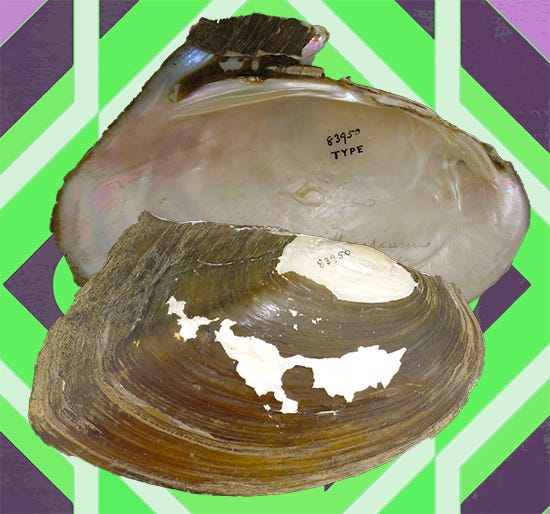
Progress in evolutionary biology often results in re-classification to better reflect the phylogenetic data. But, sometimes the algorithms of taxonomic nomenclature force a name-change for no good reason. The classification of genera like Hyriopsis and Limnoscapha is clouded by just such a stink.
Hyriopsis Conrad, 1865 is a genus of ten species found in southeast Asia, whereas Limnoscapha Lindholm, 1932 is a strictly fossil genus from the Tertiary of Eurasia. That said, lots of modern literature classifies our Mussel of the Month as Hyriopsis (Limnoscapha) myersiana (e.g., Brandt, 1974). Whether Limnoscapha is nested within Hyriopsis or treated as a closely related extinct genus, it is saddled with the baggage of an available family-group level name that messes with the nomenclature of freshwater mussels based on the flimsiest evidence.
If you with patient ears attend, I will make the case that swapping the name Limnoscaphini for Rectidentini is what Shakespeare would have described as a vexing plague — a real taxonomic wedgie.
The focus of the MUSSEL Project is Recent freshwater mussels, but we also dabble in fossil taxa.
The Recent freshwater mussels are the modern, non-fossil species. From the inception of the MUSSEL Project, our bent has been neontological — as opposed to paleontological. The MUSSEL Project Database (MUSSELpdb, for short) documents all of the valid species, genera, and families of Recent freshwater mussels and curates the data to support taxonomic research. Our raison d’être has been to discover, describe, and explain the evolutionary patterns exhibited by freshwater mussels.
The MUSSEL Project provides resources to help non-taxonomists keep up with freshwater mussel classification as well as a comprehensive database to aid taxonomic researchers. You can subscribe to this Substack to keep up with the latest news from the MUSSELp.
The MUSSELpdb has always included data on fossil freshwater mussels, although without the exhaustive effort applied to Recent taxa. We don’t claim to have all fossil species. The line dividing the research traditions of zoology and paleontology has often been fuzzy, and where works mingled the living and dead, we hoovered up those data (e.g., Modell, 1964; Haas, 1969; Starobogatov, 1970).
The International Code of Zoological Nomenclature (AKA the Code) makes no distinction between naming living species or permineralized shell fragments. The valid name for a taxon is the oldest one, fossil or not. This applies in both cases of synonymy when the same species, genus, or family has been given multiple names to choose from and homonymy when the same name has been applied to different taxa.
The Phylogenetic Era resulted in tremendous progress in freshwater mussel classification.
The marriage of modern molecular biology and computational phylogenetics has advanced the science of freshwater mussel classification by making it scientific. The centuries of taxonomic work between Linnaeus and about 2000 CE laid the foundation on which we are still building, but classification in those days relied more on authoritarian essays than explicit protocols to test hypotheses of evolutionary relationships and character transformations. I would love to be able to show a side-by-side comparison of the major 20th century classifications of freshwater mussels (Modell, 1964; Haas, 1969; Starobogatov, 1970) and our latest published checklist (Graf & Cummings, 2021), but I can’t. The differences aren’t just a matter of “lumping” and “splitting.” They are so widely divergent — which genera are arranged under what subfamily or family — that they are unalignable. The links with the references summarize the classifications in each work separately if you want to see what I mean.
When Kevin and I published our first global checklist (Graf & Cummings, 2007), we lamented the inadequacy of the current phylogenetic data to fully classify the most species-rich family, the Unionidae. Over the last two decades, the pace of phylogenetic research has picked up, and the classification has stabilized with around five subfamilies.
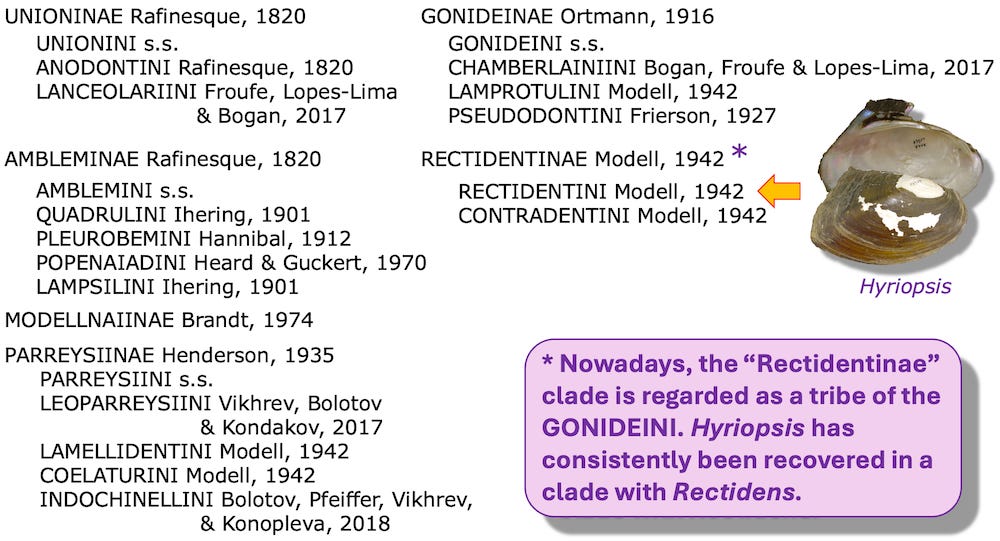
The classification of fossil freshwater mussels relies on pre-phylogenetic data.
Phylogenetic analysis of nucleotides has demonstrated that shell characters — even when combined with data from soft-anatomy — are insufficient to fully resolve the modern classification of the Unionidae. Modell (1964), Starobogatov (1970), and Haas (1969) bequeathed to us some hypotheses to test, and they have been tested.
To get a handle on Recent freshwater mussel diversity, it was necessary to resolve the conflict between Western freshwater mollusk taxonomy and Soviet/Russian Comparatory malacology. In the late 20th century, Starobogatov and many others promulgated a scheme to recognize species based on one single trait: shell curvature. Freshwater mussel shell shapes are so variable that their system resulted in an explosion of Eurasian genera and species. To move the science forward, it had to be made explicit that Comparatory species were not the same as Biological/Evolutionary/Phylogenetic species. These kinds of reckonings have happened multiple times. Charles T. Simpson famously refused to consider the species of the 19th century French Nouvelle École on the grounds that his time was too valuable (Graf, 2007).

While modern methods and philosophies have revolutionized the taxonomy of Recent freshwater mussels, paleontology hasn’t achieved the same benefit. The arrangement of fossil species into families, subfamilies, etc. still relies on the same inadequate shell characters that had misled us for hundreds of years, and it has been easy for neontologists to simply ignore much of the paleontological literature. Tellingly, the basis for classification of Limnoscapha and many other fossil genera is still rooted in old Soviet taxonomy (e.g., Starobogatov, 1970).
The hypothesized affinity of Limnoscapha to Hyriopsis is dubious but untested.
Haas (1920) and Wenz (Krejci-Graf & Wenz, 1932) described Tertiary species from Europe as Hyriopsis, considering it irrelevant that modern Hyriopsis species are strictly East Asian. What compelled assignment to Hyriopsis was the winged dorsal hinges like those of Mussel of the Month Hyriopsis myersiana. Haas (1920) argued that Hyriopsis was merely a shell shape that evolved convergently in Europe and Asia as an adaptation to lentic habitats. He was explicit that he did not think the temporal and geographic disjunctions in winged shell shapes resulted from migration between Europe and East Asia. Haas’s concept of a genus was inconsistent with our modern view of genera as monophyletic clades.
“… die gleiche generische Grundform lebt ja noch in der Gegenwart in ganz Europa und dem größten Teile von Asien, und die gleiche lakustrine Lebensweise hat in Holland, Kroatien und Südostasien ihre Umbildung zu Hyriopsis bewirkt.” … “An ihre Gattungswerdung in Ostasien und spätere Einwanderung in Europa glaube ich aus dem Grunde nicht, weil dazu eine bis jetzt noch nicht bewie sene zusammenhängende Süßwasserbedeckung des dazwischenliegen den Gebietes nötig gewesen wäre.” (Haas, 1920: 153).
Lindholm (1932) introduced Limnoscapha as a distinct genus for the alate (i.e., winged) fossil mussel species of Europe and the Soviet Union, although he thought that “... it is very possible that later it will be necessary to merge Limnoscapha and Hyriopsis as a subgenus” (p. 13, translated from Russian). The hypothesized affinity of Limnoscapha and Hyriopsis persists in the paleontological literature (e.g., Gozhik, 2006).
Taken at face value, the Limnoscapha-as-Hyriopsis hypothesis suggests that the fossil genus Limnoscapha should be arranged in whichever family, subfamily, tribe, subtribe, etc. we classify modern Hyriopsis. But, because the phylogenetic position of Hyriopsis can be reliably estimated with modern methods (see numerous references on the Hyriopsis Cladomics Page of the MUSSELpdb), the taxonomy of Limnoscapha gets laundered with a false precision that few fossil genera are afforded.
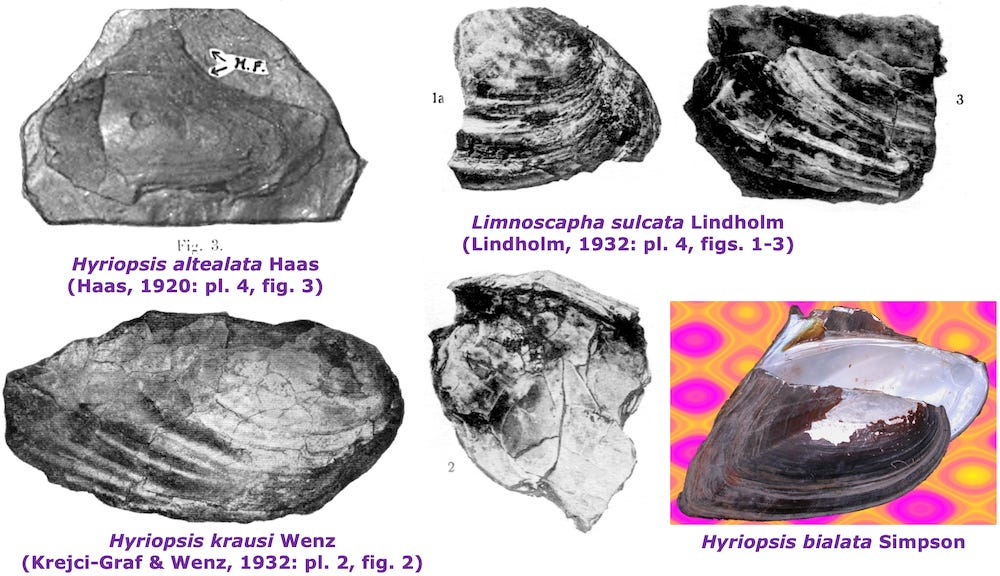
I am not a paleontologist, but for some of the shell fragments above, it is hard for me to leap from the Tertiary to the Recent and from Europe to southeast Asia to land on Hyriopsis.
Haas (1920) was correct that winged/alate shell morphologies have evolved convergently in multiple clades of freshwater mussels all over the world. The available data are insufficient to reject or confirm the hypothesis that Limnoscapha is just another independent example.
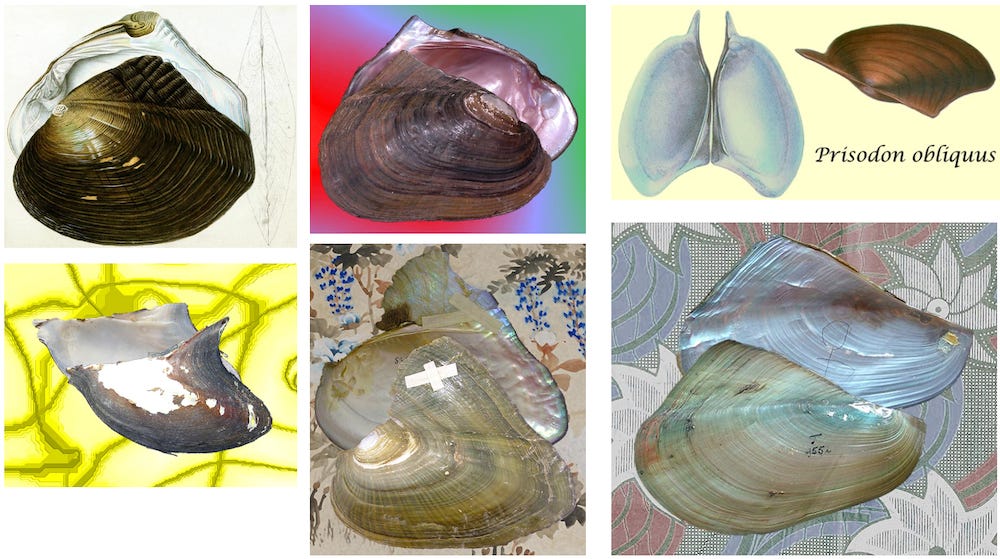
Hyriopsis itself was recently split into Hyriopsis and Sinohyriopsis when it was discovered than Chinese (Sinohyriopsis cumingii) and Japanese (S. schlegelii) species share a more recent common ancestor with the genus Chamberlainia than true Hyriopsis (Lopes-Lima et al., 2017). Until our molecular analyses, unrelated, winged species were lumped in the same genus!
The development of databases like the MUSSELpdb, MolluscaBase, etc. has manifested this reckoning of Limnoscapha with Hyriopsis. Until we started snooping around, we could just let sleeping dogs lie, but this dog is awake now.
Limnoscaphini Lindholm, 1932 is the oldest available name for the clade known as Rectidentini Modell, 1942.
The reason that zoologists can’t ignore the fossil genus Limnoscapha as a paleontological sideshow is that Lindholm (1932) introduced a family-group name. “… [species like this] differ so significantly from Unio conchologically that perhaps in the future [Limnoscapha] should be separated into a separate subfamily (Limnoscaphinae)” (translated from Russian, p. 12). According to the Code (Art. 15.1), since it was published before 1961, a conditionally proposed name can be available for nomenclatural purposes.
We had attained a relatively stable taxonomy with Hyriopsis classified in the Rectidentini Modell, 1942, but if Limnoscapha is classified in the same tribe, the valid family-group name would be Limnoscaphini Lindholm, 1932. Our tidy, scientific classification of the family Unionidae needs to be revised on a non-scientific technicality.
That stinks. Nevertheless, that is the current classification used in the MUSSELpdb — until some good science tells us otherwise. Go hence to have more talk of these sad things.
References Cited
Brandt, R.A.M. 1974. The non-marine aquatic Mollusca of Thailand. Archiv für Molluskenkunde 105: 1-423.
Gozhik, P.F. 2006. Presnovodnyye mollyuski pozdnego kaynozoya yuga vostochnoy Yevropy. Chast’ I. Nadsemeystvo Unionoidea. Natsional’naya Akademiya Nauk Ukrainy, Institut Geologicheskikh Nauk : 247 pp..
Graf, D.L. 2007. Palearctic freshwater mussel (Mollusca: Bivalvia: Unionoida) diversity and the Comparatory Method as a species concept. Proceedings of the Academy of Natural Sciences of Philadelphia 156: 71-88.
Graf, D.L. & K.S. Cummings. 2007. Review of the systematics and global diversity of freshwater mussel species (Bivalvia: Unionoida). Journal of Molluscan Studies 73: 291-314.
Graf, D.L. & K.S. Cummings. 2021. A ‘big data’ approach to global freshwater mussel diversity (Bivalvia: Unionoida), with an updated checklist of genera and species. Journal of Molluscan Studies 87(1): eyaa034 (36 pp.).
Haas, F. 1920. Unioniden aus der Tegelenstufe des Brachter Waldes. Jahrbuch der Preussischen Geologischen Landesanstalt zu Berlin für das Jahr 1919 40(2): 148-155.
Haas, F. 1969. Superfamily Unionacea. [in] R.C. Moore (ed.), Treatise on Invertebrate Paleontology Part N (1): N411-N470.
Krejci-Graf, K. & W. Wenz. 1932. Stratigraphie und Paläontologie des Obermiozäns und Pliozäns der Muntenia (Rumänien). Zeitschrift der Deutschen Geologischen Gesellschaft 83: 65-163.
Lindholm, W.A. 1932. Süsswassermollusken aus pliozaenen Ablagerungen am Fluss Irtysh. Trudy Vsesoyuznogo Geologo-Razvedochnogo Ob’edineniya NKTP SSSR 239: 3-27.
Lopes-Lima et al. 2017. Phylogeny of the most species-rich freshwater bivalve family (Bivalvia: Unionida: Unionidae): Defining modern subfamilies and tribes. Molecular Phylogenetics and Evolution 106: 174-191.
Modell, H. 1964. Das natürliche System der Najaden. 3. Archiv für Molluskenkunde 93: 71-126.
Starobogatov, Ya.I. 1970. Fauna Mollyuskov i Zoogeograficheskoe Raionirovanie Kontinental’nykh Vodoemov Zemnogo Shara. [Fauna of molluscs and zoogeographic division of continental waterbodies of the globe.] Nauka, Leningrad. 372 pp.